Share your requirements with Rotass now!
3.3L Cream Charger Tank: How to Fix Weak Output in Winter and Overpressure in Summer
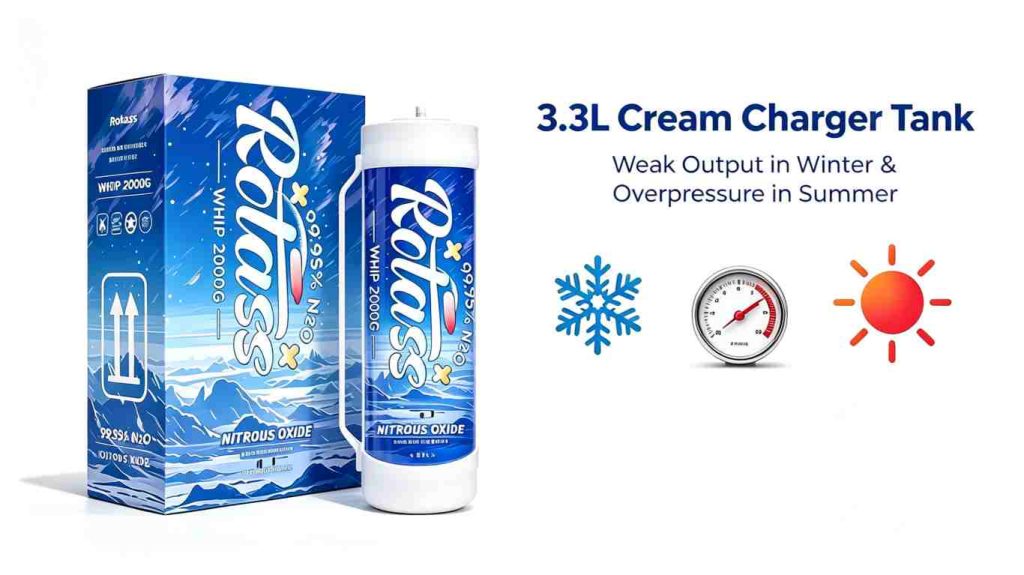
If you use a 3.3L cream charger tank in a café, dessert shop, or central kitchen, you may notice that its performance changes with the weather. In winter, the gas may flow more slowly and take longer to charge a whipped cream dispenser. In summer, the pressure reading can be much higher.
This is mainly caused by temperature. Nitrous oxide (N2O) is stored as a liquefied gas, and its vapor pressure changes as the temperature changes.
A cold tank has lower vapor pressure, so the gas output can be weaker. A warmer tank has higher vapor pressure, which means the pressure inside the tank also increases. This is why proper storage and pressure control are important, especially during hot weather.
Quick Answer
In winter, if the 3.3L cream charger tank is cold, bring it indoors and let it return to normal room temperature before use. Do not put the tank in hot water or heat it with a flame, heat gun, or other direct heat source.
In summer, keep the tank away from direct sunlight, ovens, hot equipment, and enclosed vehicles. If the tank becomes unusually hot or the pressure is higher than expected, move it to a cool, well-ventilated area and let it cool naturally.
For both winter and summer use, make sure the regulator is designed for N2O and that the working pressure stays within the rated range of the regulator and whipped cream dispenser.
Why Does Temperature Change 3.3L N2O Tank Pressure?
A filled 3.3L or 2000g N2O tank contains both liquid and gas. When the two phases are in equilibrium, the pressure inside the tank mainly depends on temperature, not simply on how much N2O is left.
For example, Air Liquide lists N2O vapor pressure at about 50.8 bar absolute at 20°C. The critical temperature of N2O is approximately 36.4°C.
| Temperature | Approx. N2O vapor pressure |
| 0°C | ~31 bar abs |
| 10°C | ~40 bar abs |
| 20°C | ~51 bar abs |
| 30°C | ~63 bar abs |
| 36.4°C | ~72.5 bar abs (critical point) |
So when the surrounding temperature changes, the pressure inside the tank changes as well. These are approximate saturation-pressure values for N2O. The actual operating pressure should always follow the rating and instructions for the specific tank and regulator.
Pressure can also drop during continuous gas withdrawal. As N2O leaves the tank, some of the liquid evaporates to replace it. This evaporation takes in heat and cools the tank. During heavy or continuous use, the tank can therefore become colder and the pressure may temporarily fall. The effect is usually more noticeable in a cold environment.
Why Is 2000g N2O Tank Output Weak in Winter?
In winter, a 2000g N2O tank may deliver gas more slowly than usual. A whipped cream dispenser may charge normally at first, then take longer after several uses. The pressure gauge can also show a lower reading.
This is more likely when the N2O tank has been stored in a cold warehouse, near an open loading area, in a cold room, or outdoors. Low temperature reduces the vapor pressure of N2O, which can reduce the gas output from the tank.
Common signs include:
- The whipped cream dispenser charges more slowly.
- N2O gas output feels weaker than usual.
- The pressure gauge shows a lower reading.
- The cream does not reach the expected texture or consistency.
The problem becomes more noticeable during repeated use.
How to Fix It
1. Let the N2O tank return to room temperature.
Move the tank to a suitable indoor storage area and let it warm up naturally. Keeping the tank around normal room temperature, such as 18–25°C, is more practical than trying to heat it quickly.
2. Do not heat the tank directly.
Never put an N2O tank in hot water or place it next to a heater. Do not use a heat gun or open flame. Direct heating can raise the tank pressure too quickly and create a safety risk.
3. Check the N2O regulator.
After the tank has returned to room temperature, check the pressure gauge, regulator, and connections. If the pressure and gas output return to normal, the low temperature was likely the main reason for the weak output.
4. Stay within the regulator’s rated pressure.
If you need more gas output, do not simply increase the regulator pressure to compensate for a cold N2O tank. The working pressure must stay within the rated range of both the N2O regulator and the whipped cream dispenser.
For cafés, dessert shops, and central kitchens with high daily N2O consumption, keeping a second 2000g N2O tank in a suitable indoor environment can also help. This gives you a ready-to-use tank while the other one returns to normal temperature.
Why Is the N2O Tank Pressure Too High in Summer?
High temperatures can cause the opposite problem. A 2000g N2O tank left beside an oven, near a sunny window, inside a delivery vehicle, or in a poorly ventilated storage area can heat up quickly.
As the temperature rises, N2O vapor pressure also increases. The pressure gauge may therefore show a much higher reading than it would at normal room temperature.
For example, N2O vapor pressure is around 63 bar absolute at 30°C, compared with about 51 bar absolute at 20°C. The pressure difference can be significant even with a relatively small change in temperature.
How to Fix It
Move the N2O tank away from direct sunlight, ovens, heaters, and other heat sources. For summer storage, keep the tank in a cool, dry, and well-ventilated area.
If the tank has become unusually hot, let it cool down naturally in a suitable storage area. Do not put a hot tank into ice water or use other methods that cause a sudden temperature change.
Once the tank has cooled, check the pressure gauge, N2O regulator, and connections. If the regulator needs adjustment, keep the working pressure within the rated range of the regulator and the connected equipment.
Do not bypass or modify the tank’s safety devices because of a high pressure reading. If the pressure remains abnormal, or you notice leakage, visible damage, or deformation, stop using the tank and contact the N2O supplier.
Temperature Issue or Equipment Fault?
Not every N2O tank pressure problem is caused by temperature. The regulator or other parts of the system may also be responsible.
A simple test is to let the N2O tank return to a normal indoor temperature and check the gas output again. If the whipped cream dispenser works normally afterward, temperature was likely the main factor. If the output is still weak or the pressure remains abnormal, check the N2O regulator, hose, valve connection, seals, and dispenser.
Leaks need more attention. Continuous hissing, frost around a connection, or visible damage to the N2O tank can indicate a gas leak or equipment problem.
If you notice any of these signs, stop using the equipment. Do not try to fix an abnormal pressure reading by simply changing the N2O regulator setting. Check the equipment according to the manufacturer’s instructions or contact the supplier for further inspection.
Safety Limits You Should Not Cross
Always follow the storage and handling instructions supplied with your N2O tank. General temperature guidance should not replace the manufacturer’s requirements.
For N2O tank storage, keep the cylinder away from direct sunlight, hot vehicles, ovens, heaters, and other heat sources. Do not leave an N2O cylinder in a poorly ventilated area where heat can build up. Safety data from major gas suppliers also lists overheating as a condition to avoid.
Check the tank label, applicable cylinder standard, and manufacturer’s instructions for the maximum storage and operating temperature. These limits can vary depending on the cylinder and its intended use.
Pressure limits are just as important. Use an N2O regulator that is compatible with the tank and whipped cream dispenser. The regulator’s output must stay within the rated working pressure of the connected equipment.
How to Store a 3.3L N2O Cylinder in Cafés and Central Kitchens
Store 3.3L N2O cylinders in a cool, dry, and well-ventilated area. Keep them away from ovens, stoves, heaters, and other cooking equipment. Direct sunlight should also be avoided, especially in areas that become hot in the afternoon.
In winter, do not leave spare N2O tanks next to open doors, loading bays, or cold rooms. If a cylinder has been stored in a very cold area, move it indoors and let it return naturally to a suitable working temperature before use.
Staff should follow a few basic rules: do not heat the N2O tank and do not expose it to excessive heat. They should also know what an unusually high or low pressure reading looks like and when the equipment should be taken out of service.
For cafés and high-volume kitchens, rotating N2O cylinders can make daily operation more consistent. Keeping spare tanks in the proper storage area also reduces the pressure changes that can occur when a cold cylinder is put into use immediately.
Choosing the Right Tank and Regulator for Your Climate
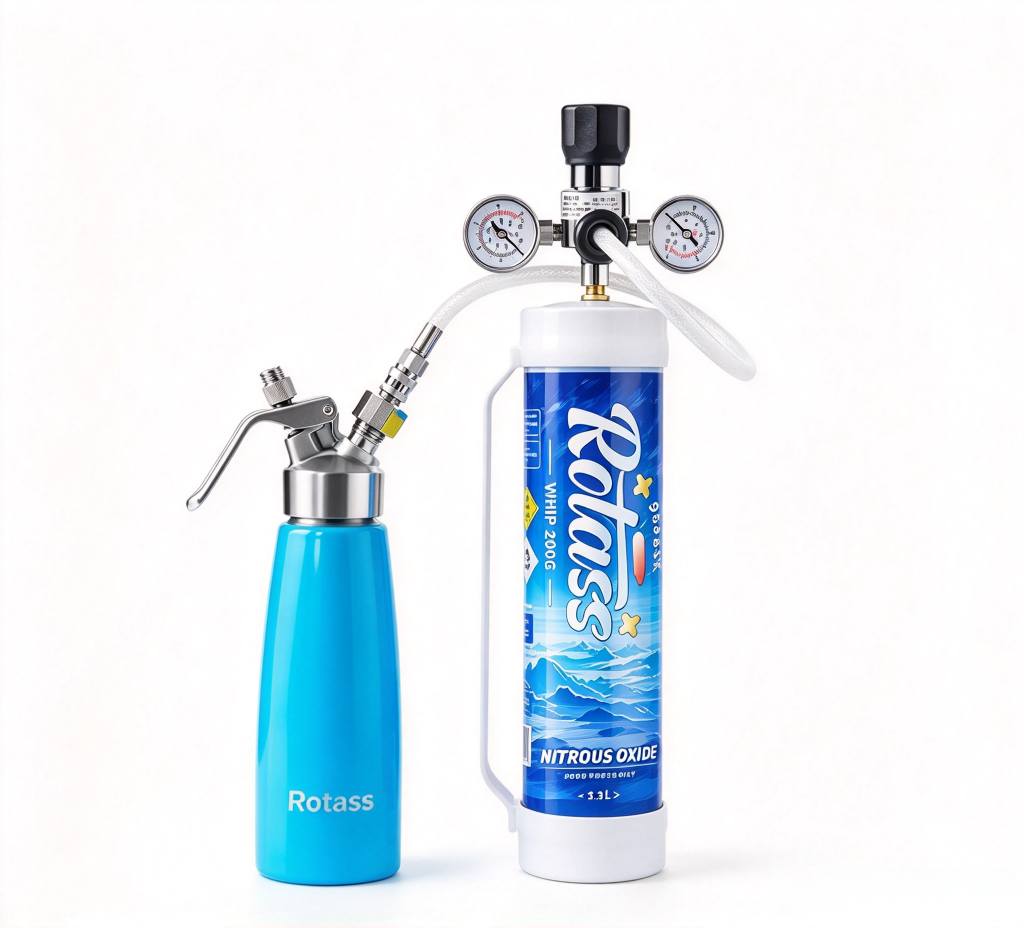
A 3.3L cream charger tank is a practical option for cafés, dessert shops, catering businesses, and central kitchens that use N2O regularly. When choosing an N2O regulator, check that it matches the tank connection and provides a suitable output pressure for the whipped cream dispenser.
A pressure gauge is also useful for daily operation. It lets staff monitor N2O tank pressure and spot unusual pressure changes before they affect gas output or production.
For bulk purchases, do not choose a commercial N2O tank based on capacity alone. Check the cylinder specifications, filling standards, inspection documents, connection type, and N2O regulator compatibility. These details are more important for reliable day-to-day use.
If you are sourcing N2O tanks or regulators for commercial applications, you can contact Rotass for product specifications and bulk purchasing requirements.
FAQ
Can I warm a cold N2O tank in hot water?
No. A cold N2O tank should be allowed to return to a suitable indoor temperature naturally. Do not use hot water, open flames, heat guns, or other direct heating methods. Rapid or uncontrolled heating can increase cylinder pressure and create an unnecessary safety risk.
What temperature is too hot for a 2000g N2O tank?
There is no single temperature that should replace the manufacturer’s specified limit. Follow the tank label and supplier instructions. As a practical rule, keep the tank away from direct sunlight, hot vehicles, ovens, heaters, and other heat sources. N2O pressure rises significantly as temperature increases.
Why does the pressure gauge read low in winter?
N2O vapor pressure decreases as temperature falls. When a tank becomes cold, the liquid inside produces less vapor pressure, so the gauge can show a lower reading and gas output may become weaker. Allowing the tank to return naturally to a suitable indoor temperature can restore normal pressure.
Does tank pressure drop as the N2O is used?
Not necessarily while liquid N2O remains in the tank. Under normal liquid-vapor equilibrium, pressure is mainly related to temperature. During heavy continuous use, however, evaporation can cool the tank and temporarily reduce pressure. Once most or all of the liquid has been consumed, the pressure will fall more directly as the remaining gas is used.
How long should I let a cold N2O tank warm up?
There is no useful universal time because the starting temperature, tank size, room temperature, and airflow are different in every workplace. Instead of relying on a fixed number of hours, allow the tank to return naturally to the normal working environment and check that it is no longer unusually cold before use.
Contact us now, and we’ll get back to you within minutes.