
Share your requirements with Rotass now!
Whipped Cream vs Coconut Whipped Cream: Calories Compared
If you’ve ever swapped whipped cream for coconut whipped cream thinking it was the lighter option, you might want to read this first. The Rotass Team put both side by side — same recipes, same serving sizes, both fully whipped — and the calorie numbers came out differently than expected.
But before the numbers, there’s a comparison problem worth fixing.
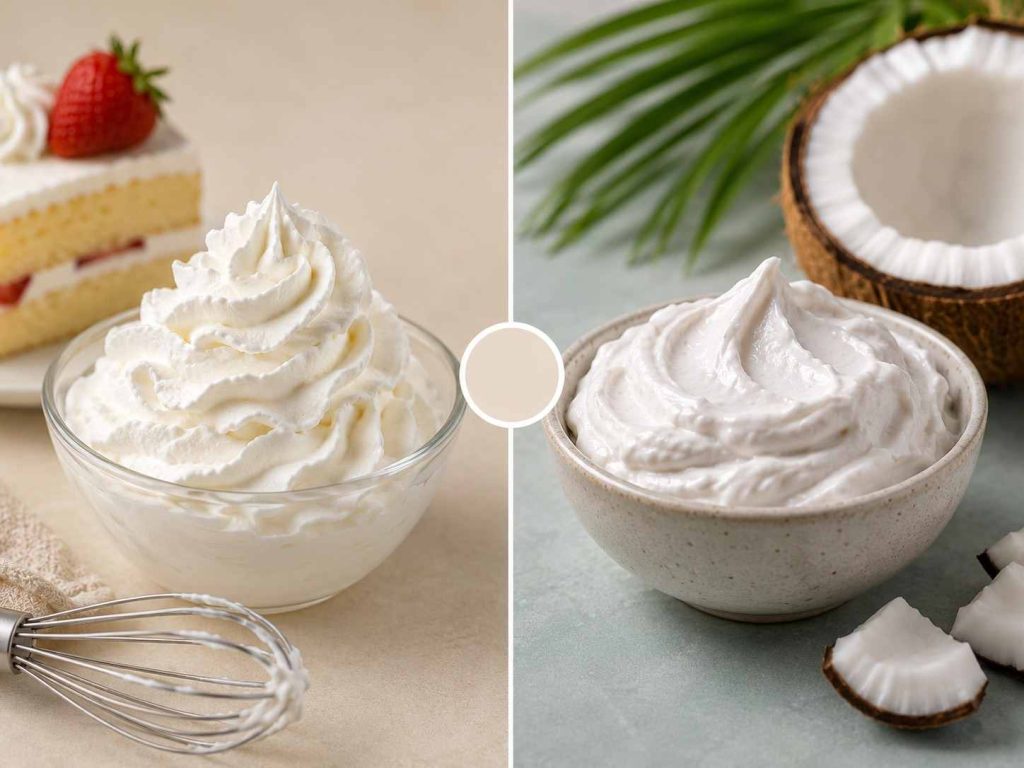
Whipped Cream vs Coconut Whipped Cream: Why Most Comparisons Get It Wrong
Most articles comparing these two make the same mistake: they measure unwhipped coconut cream against whipped dairy cream. That’s not a fair comparison. One has had air incorporated into it, the other hasn’t. Of course the numbers look different.
To make this actually useful, both need to be in their final, served form: fully whipped, ready to spoon onto your dessert or stir into your coffee.
Fresh whipped cream starts as heavy cream (minimum 36% fat) and gets aerated until it becomes light and fluffy. The most consistent way to do this at home is with a whipped cream dispenser loaded with an N2O cream charger, the gas dissolves into the fat, then expands when dispensed, creating a stable, smooth texture. You can also use a hand mixer, though the result is slightly denser.
Coconut whipped cream starts from the solid fat layer that separates at the top of a chilled can of full-fat coconut milk. Once that fat is cold and firm enough, it can be whipped by hand mixer into a fluffy, dairy-free topping.
Both are legitimate whipped toppings. Now let’s compare them on equal footing.
Whipped Cream vs Coconut Whipped Cream Calories: The Real Numbers
Here’s what the data from USDA FoodData Central and nutritional databases shows when both products are measured in their whipped state, per 2 tablespoons:
| Fresh Whipped Cream (cream charger) | Coconut Whipped Cream | |
| Calories | ~25–35 kcal | ~50–60 kcal |
| Total Fat | ~2.5–3g | ~5–6g |
| Carbs | ~0.2g | ~1–2g |
| Protein | ~0.2g | ~0.5–1g |
The gap comes from how each product whips. Heavy cream, when charged with N2O, roughly triples in volume, so the same amount of fat gets spread across a much larger, airier result. Coconut cream whips to about 1.5–2x its original volume, so the fat concentration per spoonful stays higher.
This is what most calorie comparisons miss. When you measure both in their ready-to-use form, fresh whipped cream made with a cream charger is actually lower in calories per serving than coconut whipped cream.
Related reading: Whipped Cream vs Heavy Whipping Cream: Calories and Carbs You Should Know

Fat Type, Stability, and Ingredients: What the Numbers Don’t Tell You
Calories per serving isn’t the whole story. There are a few other differences that matter depending on how and why you’re using each one.
Fat composition is different. Heavy cream contains long-chain saturated dairy fat. Coconut whipped cream is built on medium-chain triglycerides (MCTs). According to Harvard T.H. Chan School of Public Health, MCTs are metabolized differently — they’re absorbed more quickly and less likely to be stored as fat. That said, both are calorie-dense, and neither should be treated as a free pass on portions.
Stability at room temperature is not the same. Fresh whipped cream made with a cream charger holds its shape well — the N2O creates a stable structure that keeps texture intact for hours. Coconut whipped cream is more fragile. It deflates faster at room temperature and often requires refrigeration to hold its shape. If you’re serving at a party or adding a topping that needs to last, this is a real practical difference.
Ingredient simplicity varies. Fresh whipped cream from a charger contains one ingredient: heavy cream. No stabilizers, no additives. Coconut whipped cream from a can of full-fat coconut milk is similarly clean typically just coconut extract and water, depending on the brand. Both are straightforward, which puts them ahead of many processed alternatives.
Dairy is dairy. For anyone vegan, lactose intolerant, or simply avoiding dairy for dietary or ethical reasons, fresh whipped cream is off the table regardless of its calorie count. Coconut whipped cream fills that gap well.
Coconut Whipped Cream vs Regular Whipped Cream Calories in Everyday Portions
Numbers per tablespoon are useful, but portion size in real life rarely comes down to a measuring spoon. Here’s what the calorie difference actually looks like in common situations.
On your morning coffee: A standard dollop is about 2 tablespoons. Fresh whipped cream from a charger adds roughly 25–35 calories. Coconut whipped cream brings that closer to 50–60 calories. Not a dramatic gap, but if you’re having one every day, it adds up over a week.
As a dessert topping: Most people spoon on 3–4 tablespoons over fruit or a slice of cake. That puts fresh whipped cream at around 40–50 calories, and coconut whipped cream at around 75–120 calories for the same coverage.
In a no-bake cheesecake: The Rotass Team tested the same recipe with both — once using fresh whipped cream made with a Rotass cream charger, once using whipped coconut cream as the base. The coconut version came out around 120–150 calories more per slice. Still reasonable either way, but consistent across every serving.

The calorie difference between the two is real, but it’s modest. For most people, other factors will matter more, like dietary restrictions, flavor preference, what the recipe actually calls for.
99.95% purity · OEM · Low MOQ · Local delivery
Is Coconut Whipped Cream Healthier Than Regular Whipped Cream?
This question doesn’t have a clean answer, and any article that gives you one is probably oversimplifying.
Here’s a more honest breakdown:
Choose fresh whipped cream if you want a lower-calorie topping by volume, you’re not avoiding dairy, and you want the cleanest possible result with no added ingredients. A cream charger setup gives you control over density, and you’re working with a single-ingredient product.
Choose coconut whipped cream if you’re vegan or dairy-free, you want MCT fats over dairy fats, or you simply prefer the flavor. It works well as a topping for cold desserts and room-temperature drinks, though it needs to be served promptly.
For keto or low-carb diets, fresh whipped cream from heavy cream is the stronger fit — very low carbs, high fat, no added sugar when made fresh.
For baking, neither is a simple drop-in substitute for the other. They behave differently when folded into batters or heated, so test before committing to a swap.

The Rotass Team’s Honest Take
After testing both side by side, the main takeaway is this: when both are properly whipped, fresh whipped cream from heavy cream is lower in calories per serving than coconut whipped cream. That surprised us, because the plant-based option tends to get labeled as the “lighter” choice by default.
Coconut whipped cream has real advantages — it’s dairy-free, the MCT fat profile is genuinely different, and the flavor suits certain recipes well. But it’s not the lower-calorie option when you measure correctly.
The honest answer is that your dietary needs and what you’re making matter more than which one sounds healthier. Both are real-ingredient, relatively clean products. Neither is a guilt-free free-for-all.
Want to make fresh whipped cream at home with zero additives? Here’s show how to use cream charger to make desserts. Or explore more about Rotass Recipes.
FAQs
Is coconut whipped cream lower in calories than regular whipped cream?
No, when both are measured in their whipped state, fresh whipped cream from heavy cream (made with a cream charger) is typically lower in calories per 2-tablespoon serving, around 25–35 kcal versus 50–60 kcal for coconut whipped cream.
Why does fresh whipped cream have fewer calories when whipped?
Because N2O cream chargers aerate the cream significantly, the volume roughly triples, spreading the same amount of fat across a larger, lighter result. Coconut cream whips to a smaller volume increase, so the calorie density stays higher per spoonful.
Can I substitute coconut whipped cream for regular whipped cream?
For cold toppings and no-bake desserts, yes, though the coconut flavor will come through and stability at room temperature is lower. For baked recipes, test first as the two behave differently under heat.
Which is better for a dairy-free diet?
Coconut whipped cream is the clear choice, it contains no dairy and is suitable for vegan diets. Fresh whipped cream is made from heavy dairy cream and is not dairy-free.
Is whipped cream from a cream charger the same as canned whipped cream?
No. Canned aerosol whipped cream typically contains stabilizers, emulsifiers, and added sugar. Fresh whipped cream made with a cream charger contains only heavy cream — the charger provides the N2O gas to aerate it, with nothing else added.
Chat with us on Whatsapp, we’ll sort you out in minutes.