
Share your requirements with Rotass now!
How to Make Starbucks Cold Foam at Home (4 Flavors)
Cold foam has quietly become one of the most ordered add-ons at Starbucks. It shows up on cold brews, iced lattes, matcha drinks, pretty much anything served over ice. And at $1.00 to $1.50 extra per order, it adds up fast if you’re a daily coffee drinker.
The frustrating part is that most people who try to make it at home end up with something that looks right for about 90 seconds, then collapses into the drink. The foam is too coarse, too thin, or just doesn’t sit the way it does at the store. That’s not a recipe problem, it’s a method problem. And once you understand what Starbucks is actually doing, the fix becomes obvious.
Rotass supplies food-grade N2O chargers to cafés, bubble tea shops, and home users across the market. Cold foam is something we work with daily, so when we say a method works, it’s based on actual testing not just recipe comparisons. Here’s the full breakdown, what Starbucks cold foam really is, why common home attempts fall short, and four flavor recipes you can actually pull off at home.
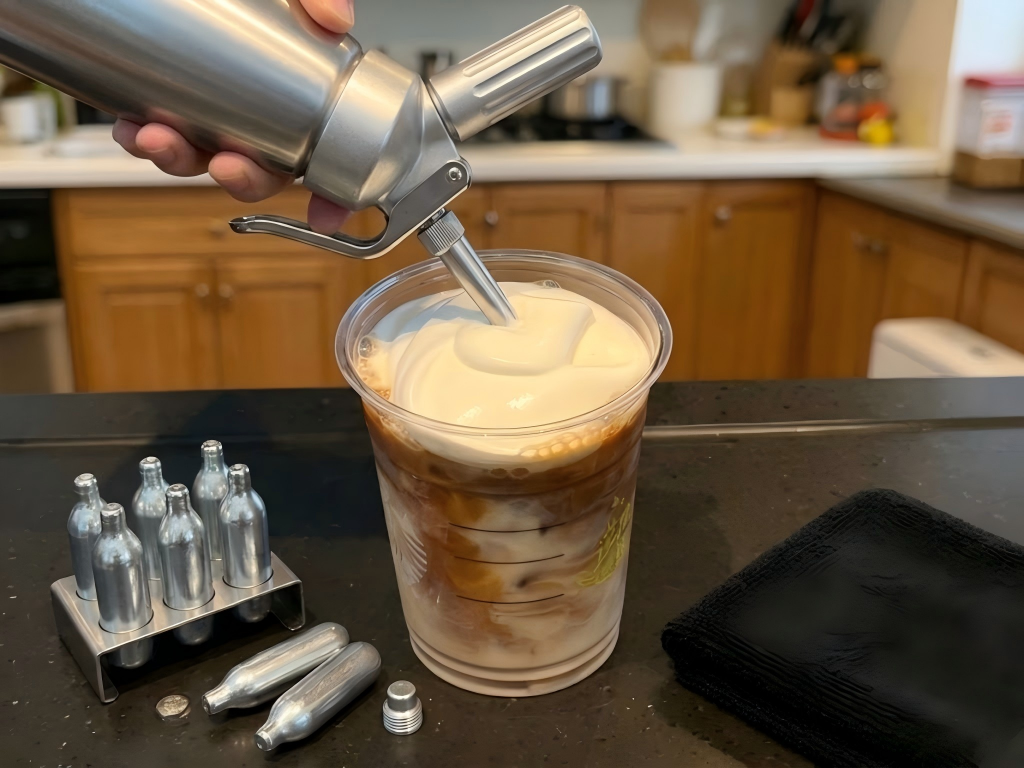
What Is the Recipe of Starbucks Cold Foam?
Cold foam isn’t whipped cream, and it’s not steamed milk foam. It sits somewhere in between, which is cold, thick, and dense enough to float on top of a drink without immediately dissolving into it.
Starbucks makes theirs using nonfat milk and a high-speed blending system designed specifically for cold aeration. No heat involved. The result is a foam with very fine bubbles and a smooth, almost creamy texture, despite using milk with virtually no fat in it. That last part is actually the key. Nonfat milk has a higher protein-to-fat ratio, and milk proteins are what stabilize foam. Fat, counterintuitively, works against foam formation by interfering with those protein bonds. That’s why Starbucks doesn’t use whole milk or cream for the base foam even when the flavor itself contains cream.
This is also why cold foam behaves differently from steamed foam. Steamed foam is designed to integrate into the drink as you pour. Cold foam is designed to stay on top, which is what gives iced drinks that layered look and a different flavor hit with each sip.
Why Your Homemade Cold Foam Probably Didn’t Work
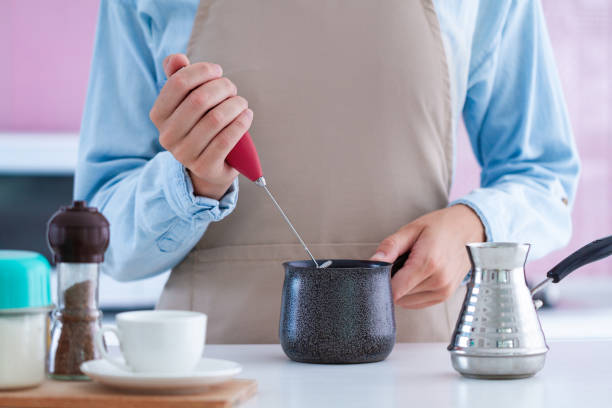
If you’ve already tried making cold foam at home with a handheld electric frother, and the result probably wasn’t quite right, you’re not alone. The foam either came out too bubbly and airy, collapsed within a few minutes, or just sat there looking more like foam on a latte than the dense cloud you get at Starbucks.
There are usually three reasons for this. First, handheld frothers work by spinning a coil at high speed to whip air into the milk but the bubbles they create are relatively large and loosely structured. They don’t have the fine, even consistency that comes from pressurized aeration. Second, most people reach for whatever milk is in the fridge, which is often whole milk or 2%. As mentioned above, higher fat content actually makes foam harder to form and maintain. Third, temperature matters more than most recipes mention, the milk needs to be cold, ideally straight from the fridge at around 4°C. Even room temperature milk produces noticeably weaker foam.
None of this means a handheld frother is useless. It’s fine for hot drinks where the foam integrates anyway. But for replicating Starbucks cold foam specifically, it consistently falls short.
The Closest You Can Get: N2O Whipper Method
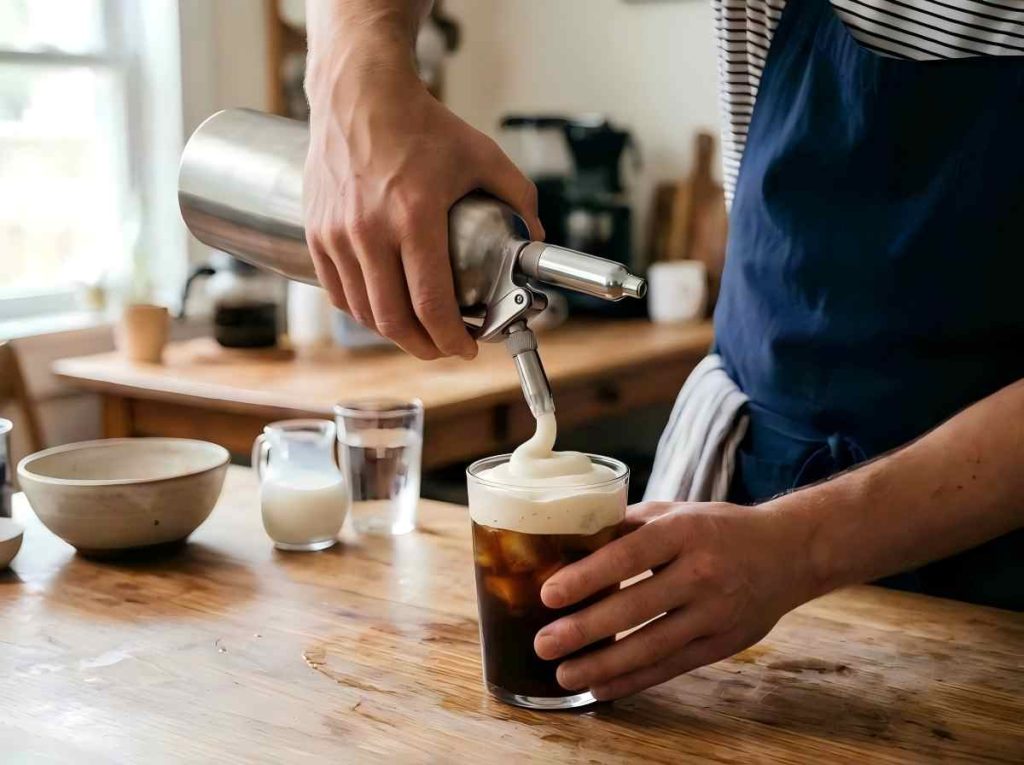
The method that actually gets you there is an N2O (nitrous oxide) cream whipper. This is the same tool used to make whipped cream at home and in professional kitchens but it also happens to be the closest consumer-level equivalent to what Starbucks uses at scale.
Here’s why it works: when you charge the whipper with an N2O cartridge and shake it, the gas dissolves into the cold milk under pressure. When you release the lever, that pressure drops rapidly and the dissolved gas forms thousands of extremely fine bubbles throughout the liquid. The result is a dense, smooth foam with a structure that holds for several minutes, significantly longer and more stable than anything a handheld frother produces. Research on nitrous oxide in food applications confirms that N2O’s solubility in fat-based and protein-based liquids is what drives this texture, it integrates at a molecular level rather than just sitting in the liquid as trapped air pockets.
To make cold foam with an N2O whipper:
Pour cold nonfat milk into the whipper. Fill it to the max line — typically 500ml for a standard whipper. Screw in one food-grade 8g N2O charger and tighten the head fully. Shake the whipper firmly six to eight times, then let it rest upright for about 30 seconds. When you’re ready to pour, hold the whipper upside down and dispense slowly over the top of your drink. The foam should come out dense and smooth, not airy or liquid.
One 8g N2O charger is enough for a standard 500ml batch. If you want slightly thicker foam which is closer to the texture of Starbucks’ vanilla sweet cream cold foam, you can replace a small portion of the nonfat milk with heavy cream (about 2–3 tablespoons per 500ml). Just note that increasing fat content does soften the foam slightly, so don’t overdo it.
For cafés, bubble tea shops, or anyone producing cold foam in volume, N2O whippers and chargers are also a practical and cost-efficient alternative to dedicated cold foam machines, the output quality is comparable, and the equipment cost is a fraction of commercial aeration systems.
4 Starbucks Cold Foam Flavors You Can Make at Home
Once you have the base technique down, the flavor variations are straightforward. All four recipes below are made using the N2O whipper method above. Adjust sweetness to taste, Starbucks tends to run on the sweeter side, so scale back if you prefer a subtler flavor.
1. Classic Vanilla Sweet Cream Cold Foam
This is the one that started the cold foam trend and still the most ordered. Mix 400ml nonfat milk with 3 tablespoons of heavy cream and 2 tablespoons of vanilla syrup (Torani or homemade simple syrup with vanilla extract both work). Charge with one N2O cartridge, shake, and dispense. The cream adds richness without destabilizing the foam, and the vanilla comes through cleanly. Pairs well with cold brew or iced Americano.
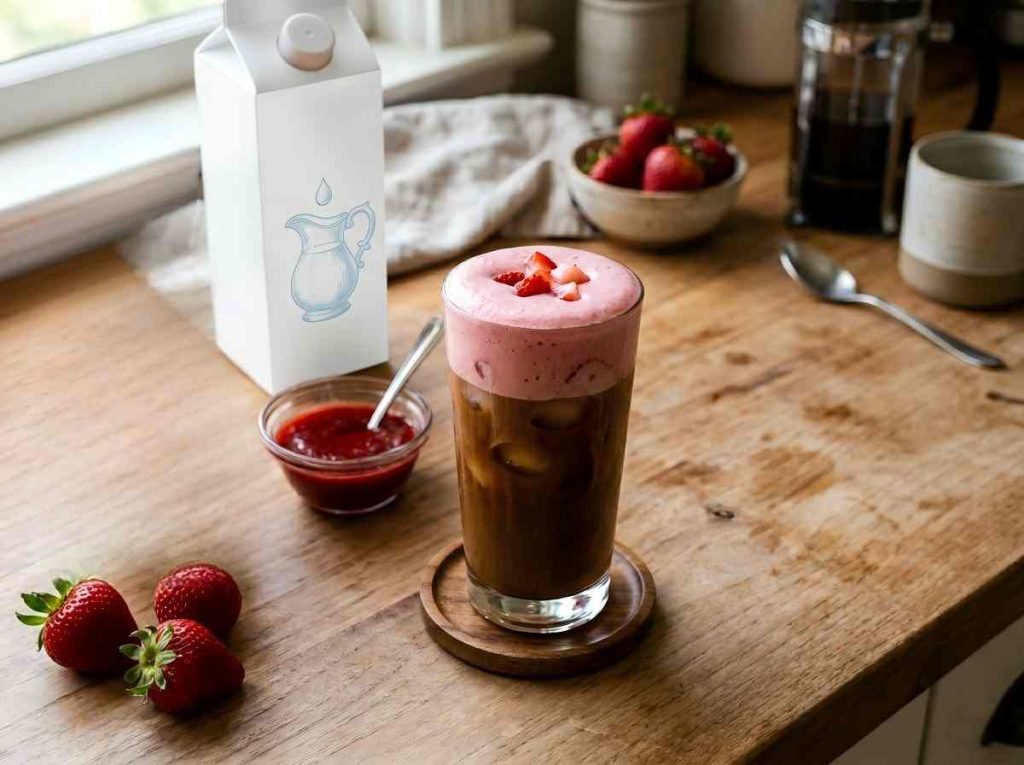
2. Strawberry Cold Foam
Starbucks uses a strawberry puree blend for this one. At home, mix 450ml nonfat milk with 2–3 tablespoons of strawberry puree or a quality strawberry syrup. Keep the fruit content measured, too much sugar from the syrup will suppress foam formation, so if you’re using a sweetened syrup, reduce any additional sugar. The pink color is part of the appeal, so a vibrant puree will get you closer to the visual. Pairs well with iced green tea latte or any citrus-forward cold drink.
3. Brown Sugar Cinnamon Cold Foam
Combine 480ml nonfat milk with 1.5 tablespoons of brown sugar syrup (dissolve brown sugar in equal parts hot water and let it cool first). Charge and dispense as normal, then dust the top of the foam with ground cinnamon after pouring, don’t add the cinnamon into the whipper itself, as the powder can clog the nozzle or cause uneven discharge. The warm spice against the cold foam works especially well on an iced espresso drink or cold brew.
4. Matcha Cold Foam
Whisk 1 teaspoon of ceremonial-grade matcha powder with 2 tablespoons of warm water until fully dissolved, then let it cool completely before adding to your milk base. Combine with 470ml nonfat milk and a teaspoon of honey or simple syrup. Charge with N2O and dispense. The key step is cooling the matcha solution first — adding warm liquid to the whipper affects the aeration temperature and weakens the foam. The color should be a clean, pale green. Pairs well with iced hojicha or an iced latte with a nutty espresso.
Starbucks vs. Homemade — Is It Actually Worth It?
| Starbucks | Homemade (N2O Whipper) | |
| Cost per serving | $1.00–1.50 add-on | ~$0.20–0.30 |
| Flavor options | Menu-limited | Fully customizable |
| Prep time | Instant | ~2 minutes |
| Texture match | Original | ~90% |
If you drink two or more cold foam drinks per week, the math works out fairly quickly. A quality N2O whipper runs $30–50, and a pack of food-grade N2O chargers brings the per-use cost well below $0.50 including milk. You’re also not limited to what’s on the seasonal menu.
That said, Starbucks does have an edge in pure consistency and speed, their equipment is calibrated for high-volume output, which a home whipper can’t fully replicate at scale. For personal use, though, the difference in daily practice is minimal.
FAQs
What milk does Starbucks use for cold foam?
Starbucks uses nonfat milk as the base for most cold foam variations. The low fat content is intentional, it produces a more stable, structured foam than whole or reduced-fat milk.
Can I make cold foam without a whipper?
You can, but the results will be noticeably different. A French press or handheld frother will produce foam, but it will be coarser and less stable. For occasional use it’s fine; for consistent results, the N2O whipper is the better tool.
How long does homemade cold foam last?
Foam dispensed from an N2O whipper holds its structure on a drink for 3–5 minutes. Unused foam stored inside a sealed, charged whipper can be refrigerated and used within 24 hours, just re-shake before dispensing.
Can I use oat milk or almond milk?
Barista-grade oat milk works reasonably well because manufacturers add stabilizers that improve foam performance. Standard almond milk is harder to work with, it tends to produce thin, fast-collapsing foam. If you’re using a plant-based milk, barista formulas are specifically designed for this and will give you better results.
Is N2O safe for food use?
Yes. The FDA classifies nitrous oxide as Generally Recognized as Safe (GRAS) for use as a propellant in whipped cream dispensers. Use chargers that are explicitly labeled food-grade, follow the fill-line on your whipper, and never exceed the recommended charger count for your whipper’s capacity.
Chat with us on Whatsapp, we’ll sort you out in minutes.